


170 Students Experience an In-Depth Project Week in English: A Project Report from Schmalkalden
- Jun 10
- 7 min read
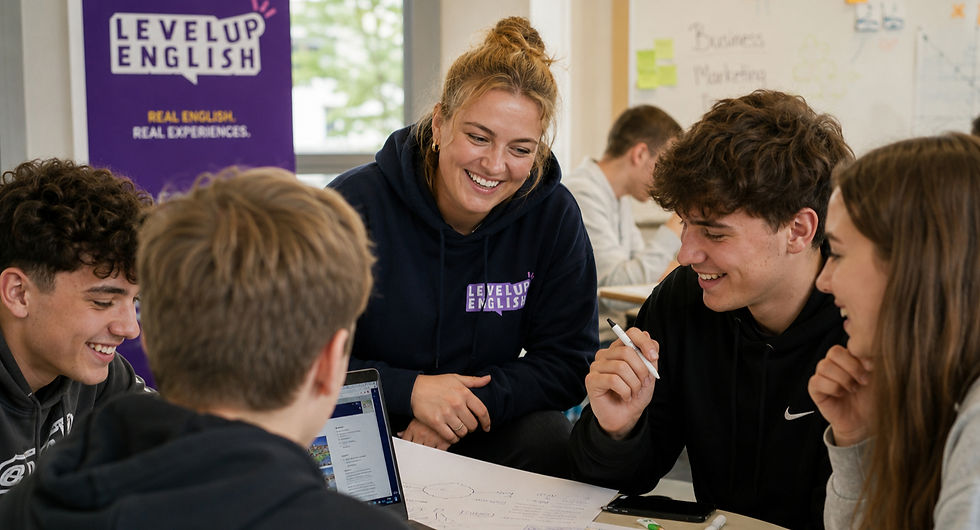
Last week, LevelUp English completed one of its largest school projects to date, a five-day English immersion programme at the Berufsbildungszentrum Schmalkalden, a vocational school in the heart of Thuringia. Eleven LevelUp trainers worked with 170 students within three distinct academies running simultaneously across the school, each with its own focus, its own final product, and its own energy.
The teacher who organised it summed it up in four words:
"The week was perfect."
That's a high bar to meet with 170 vocational students, many of whom would not have described themselves as English learners going in. Here's what the week looked like.
Three Academies, One Week, One School
The Schmalkalden project ran three programmes in parallel, each tailored to a different group of students and a different set of outcomes.
The Startup Academy challenged students to build something from scratch. Not a presentation about a business idea, but an actual business: complete with branding and marketing strategy, a revenue model, social media presence, and a working website or app prototype. This hard work culminated in a pitch to the investors of Schmalkaden: In the style of Dragons Den, they had a few short minutes to convey their entire business strategy to stern-faced investors with many tough questions. Students rose to that pressure through the passion they’d developed for their products, and in ways that a worksheet simply could not produce.
The Arts Academy set out to make things: films, music, posters, creative work that hadn't existed on Monday morning. By the end of the week, students had written, shot, edited, and screened short films; recorded original audio; designed visual work; and stood up in front of their peers to present it all in English. They had film posters and a short speech to boot, and the crowd at the Schmalkaden Film Festival were thrilled with the results. The output from a group with no film training, working in a second language, over five days, was really quite remarkable.
The Growth Academy took a different angle. Rather than building an external product, students turned inward, taking on a week of personal challenges and using creative tools (theatre, interviews, podcasts) to articulate and present their own growth. It's the hardest sell to a group of teenagers. It also tends to produce the most memorable moments of the week.
All three ran simultaneously, catering to each of the students personalities and aptitudes, and all three ran entirely in English.
What the Numbers Say
After the week, 92 students completed LevelUp's feedback survey. Here's what they reported:
92% rated the project "good" or "great"
93% said they spoke more English during the week than usual
99% said they learned something new
The trainer scores tell a similar story. Across all eleven trainers and all three academies, the average rating from students was 4.84 out of 5. 86% of students gave their trainer the maximum possible score.
What Students Said, in Their Own Words
The feedback forms ask students to write in the language they spent the week using. These are their words, unedited:
"I liked Frieda's active and funny personality. She always made us feel good about our project and gave us a sense of 'you got this' and 'you're perfect' — like school rarely does."
"I loved that we could only talk English!"
"I really liked how complex filming is and how much you had to do. It was so fun to learn about different arts and making a movie. I enjoyed it so much, I wish I could do it one more time."
"I liked that I learned a lot about myself and how to handle certain situations. A lot of things I learned I now do in my own time. I really think this project was useful for me personally."
"I liked the improv game and filmmaking the most."
"She is very open and amazingly friendly to everyone. An amazing teacher."
These responses show that this project was far more than a tick-box exercise, or a week to be tolerated. The enthusiasm, specificity and appreciation in the answers shows that the students were up for the task.
Why Vocational Students? Why Schmalkalden?
There's a tendency to assume that English immersion programmes are for students already interested in languages, already confident, already heading somewhere that makes English feel relevant. But that assumption doesn't hold, and Schmalkalden is a reasonable illustration of why.
The working world vocational students are entering, across engineering, design, trade, logistics, healthcare, and tech, runs on international collaboration and professional English to a degree that would have been hard to predict twenty years ago. Communicating confidently in English is no longer a bonus for this generation entering the workforce. It's increasingly a basic requirement.
Beyond that, the skills a week like this builds - presenting under pressure, working creatively in a team, making a pitch, getting out of your comfort zone in front of others - are exactly the skills vocational education is trying to develop. LevelUp's approach delivers them in English.
The 99% "learned something new" figure from Schmalkalden students makes the case fairly clearly.
What Made It Work
The highlights students kept returning to in their feedback were consistent across all three academies: creative project work (short films, podcasts, vision boards, app development), games and warm-up activities that brought the group together, interviews with other students and members of the public, theatre and improvisation exercises, the energy of the trainers, and practical content that went well past normal school life.
What's notable is that "speaking English" doesn't appear anywhere on that list. Students were talking about what they made, who they met, and how they felt. The English was the medium, not the point, which is precisely how LevelUp designs it.
The trainers, eleven of them, native English-speaking creative professionals, carried a significant part of this. A 4.84 average from 170 teenagers is not an accident. It reflects a team that brings genuine craft to the work and knows how to read a room, adapt to a group, and keep energy high across five days with students who didn't choose to be there.
What Comes Next
The Schmalkalden project is one of more than 150 LevelUp programmes running across Germany in 2026. It's part of a broader picture: a company that started with a handful of camps in Berlin and has grown, primarily through word of mouth and repeat bookings, into a provider working with schools across all sixteen Bundesländer.
If you're a teacher or school administrator thinking about what a project week in English could look like for your students, at your school, with your curriculum, for your specific year group, this is what it looks like when it works.
The week was perfect. We're already looking forward to the next one.
Interested in bringing a LevelUp project week to your school?
We work with schools across Germany to design English immersion programmes that fit your students, your timetable, and your goals. Get in touch with us and we can start planning the week your students will never forget.
Frequently Asked Questions
What is a LevelUp Project Week?
A LevelUp Project Week is a five-day English immersion programme delivered directly at your school. Students spend the week working on a themed project, collaborating in English, and creating a final product such as a business pitch, short film, podcast, performance, or presentation.
Who are Project Weeks designed for?
Our programmes work with a wide range of age groups, from lower secondary students through to vocational schools and upper secondary education. Every programme is adapted to the age, interests, and English level of the students involved.
Do students need strong English skills to participate?
No. Our programmes are designed for mixed-ability groups. Students are encouraged to communicate in English from day one, but activities are structured so that learners at different levels can participate successfully and build confidence throughout the week.
How many students can take part?
Project Weeks can be delivered for a single class, an entire year group, or even a whole school. The Schmalkalden programme involved 170 students working across three academies simultaneously.
What kinds of projects can students work on?
Schools can choose from a range of academies and themes, including entrepreneurship, filmmaking, theatre, creative arts, personal development, leadership, media production, sustainability, and more. We also design bespoke programmes around specific educational goals.
Who leads the programme?
All programmes are delivered by LevelUp trainers: native English-speaking professionals with experience working with young people. Many come from backgrounds in education, business, media, theatre, the arts, and entrepreneurship.
Is the programme taught entirely in English?
Yes. English is the working language throughout the week. Rather than studying English as a subject, students use English to solve problems, create projects, collaborate, and present their work.
What does a typical day look like?
Days usually combine energisers, workshops, project work, team activities, coaching sessions, and presentation preparation. The exact structure depends on the academy and the goals of the school.
How does the programme fit into our curriculum?
Project Weeks complement existing curricula by developing communication skills, teamwork, creativity, presentation skills, critical thinking, and confidence, all while providing meaningful English-language practice.
Do students receive a final presentation or showcase?
Yes. Every programme includes a final outcome. Depending on the academy, this might be a pitch competition, film festival, exhibition, performance, podcast showcase, or presentation event attended by teachers and fellow students.
Can different academies run at the same time?
Absolutely. Many schools choose to offer multiple academies simultaneously, allowing students to select a pathway that matches their interests and strengths.
How many trainers are needed?
The number of trainers depends on the size of the programme. We work closely with schools to determine the appropriate staffing ratio to ensure every group receives high-quality support.
What results do schools typically see?
Schools regularly report increased student confidence, higher levels of spoken English, stronger teamwork, and greater engagement than traditional classroom activities. In Schmalkalden, 93% of surveyed students said they spoke more English than usual, and 99% reported learning something new.
Can the programme be customised for our school?
Yes. Every Project Week is tailored to the school's timetable, student profile, educational goals, and logistical requirements.
Where in Germany do you operate?
LevelUp works with schools across all sixteen German Bundesländer and delivers more than 150 programmes each year.
How far in advance should we book?
Many schools book several months in advance, particularly for popular project week periods. We recommend getting in touch early to secure preferred dates.
How do we start planning a Project Week?
Simply contact the LevelUp team. We'll discuss your students, goals, timetable, and budget, then design a programme tailored to your school.


Comments